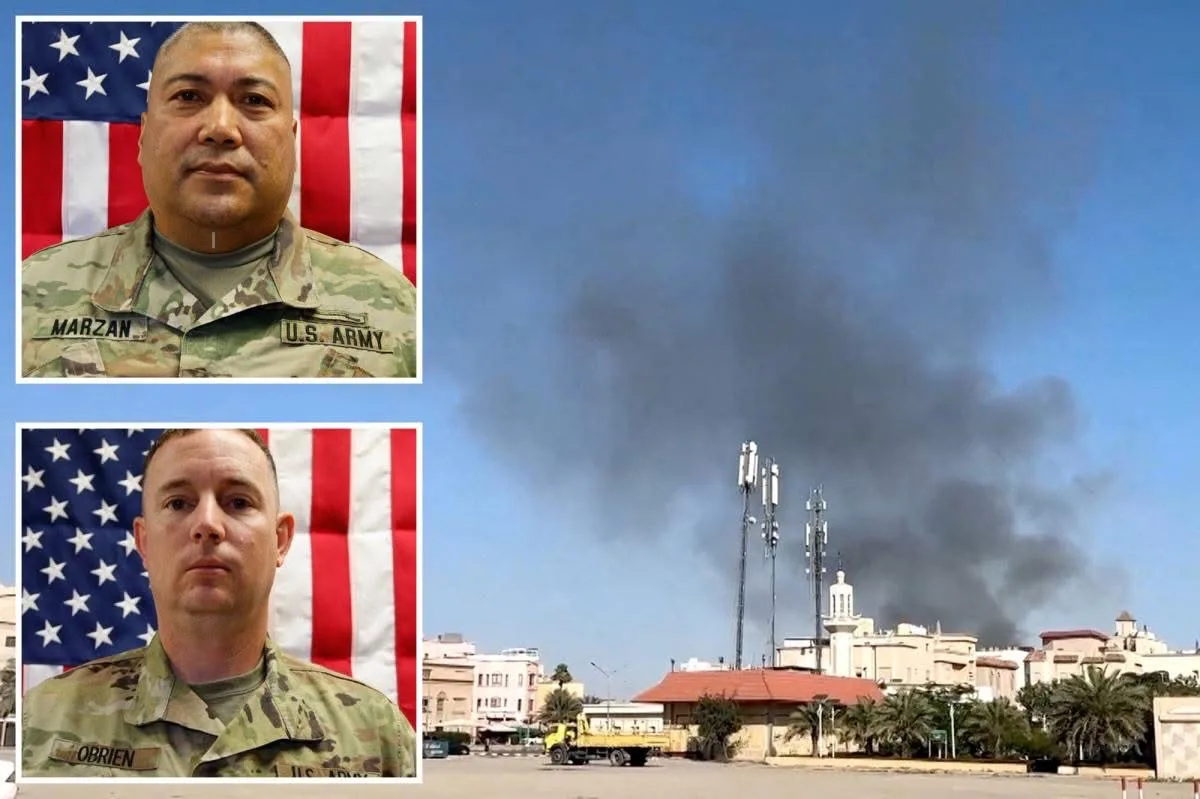
The Pentagon identified the final two soldiers killed in a March 1 Iranian drone strike on Port Shuaiba, Kuwait, bringing the total death toll of the attack to six U.S. service members.
WASHINGTON — The Pentagon has identified the final two service members among the six U.S. soldiers killed in an Iranian drone attack in Kuwait.
The two service members were identified as:
- Major Jeffrey R. O’Brien, 45, of Indianola, Iowa
- Chief Warrant Officer Robert M. Marzan, 54, of Sacramento, California
According to the U.S. Department of Defense, Major O’Brien was killed after an Iranian kamikaze drone directly struck a temporary command center at Port Shuaiba, Kuwait.
Chief Warrant Officer Marzan is also believed to have died at the scene; formal identification is pending final forensic confirmation.
Total of 6 U.S. Soldiers Killed
The attack occurred on Sunday, March 1, 2026, targeting a military operations center located within the Port Shuaiba civilian port complex.
Previously, the Pentagon had announced the names of four other soldiers killed in the same attack, including the
fourth U.S. service member who died following the initial strikes:
- Capt. Cody A. Khork, 35, Florida
- Sgt. 1st Class Noah L. Tietjens, 42, Nebraska
- Sgt. 1st Class Nicole M. Amor, 39, Minnesota
- Sgt. Declan J. Coady, 20, Iowa
All were assigned to the 103rd Sustainment Command of the Army Reserve, a logistics unit based in Des Moines, Iowa.
One of Iran's First Retaliatory Strikes
According to defense officials, the low-flying drone evaded air defense systems, similar to the way
Iran attacked the Ras Tanura refinery with drones that caused heavy damage previously. The device struck a containerized housing unit/trailer where the soldiers were working.
The attack occurred as Iran conducts retaliatory strikes across the Middle East following U.S. and Israeli military operations against Iran, while incidents such as the
two U.S. service members surviving an F-15E crash in Kuwait are also under active investigation.
U.S. officials stated that the investigation is ongoing to determine why defense systems failed to detect the drone in time and to re-evaluate protection levels at regional military facilities, where
U.S. forces in the Middle East are ready for high-intensity operations under orders from the highest levels.
Read More