
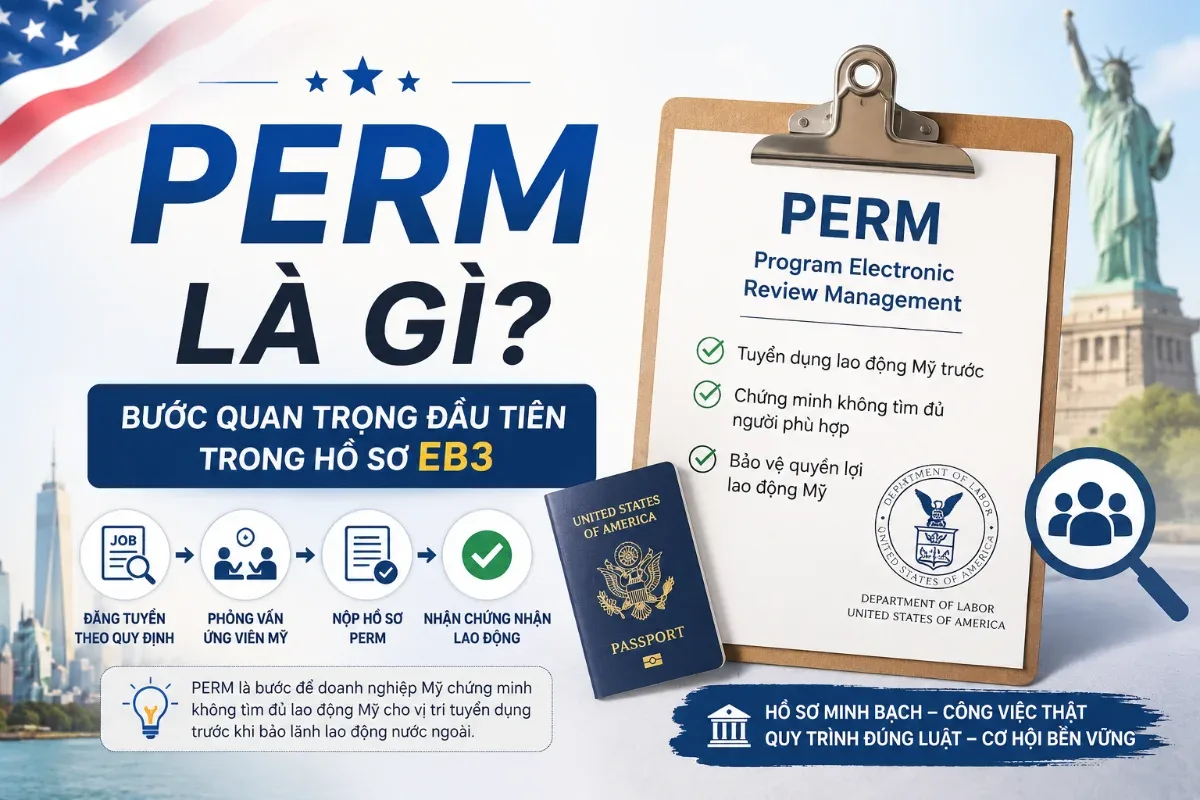
While researching the EB3 employment-based immigration category, many people often hear the term “PERM” but do not truly understand what this step entails and why it is so important.
According to the U.S. Department of Labor, PERM is the mandatory labor certification procedure for the majority of EB3 and EB2 immigration cases. It is considered the first step before a U.S. business can officially sponsor a foreign worker for a Green Card.
Put simply, PERM is the process where a U.S. company proves they have attempted to recruit domestic workers but could not find enough qualified candidates for the position.
During this process, the business must:
• Post job advertisements according to regulations
• Interview candidates if there are applicants
• Prove the job opening is legitimate
• Demonstrate that the wage meets U.S. Department of Labor standards
After completing the domestic recruitment steps, the business can then file the PERM application with the U.S. Department of Labor to request labor certification.
If the PERM is approved, the application can move to the next step: filing Form I-140 with U.S. Citizenship and Immigration Services (USCIS).
Immigration lawyers state that PERM processing times are currently longer than before due to a high volume of applications and increasingly strict review processes. Some cases are even “audited”—meaning they undergo additional inspection—which can delay waiting times by several months.
Experts also warn workers to be especially cautious of advertisements promising “guaranteed fast approval,” “no real company needed,” or “express processing.” Non-transparent applications can lead to visa denials or affect future U.S. immigration eligibility.
According to many immigration agencies, the most important factor in the EB3 process is not speed, but ensuring the application is legal, the job is real, and the process is transparent from the very first PERM step.