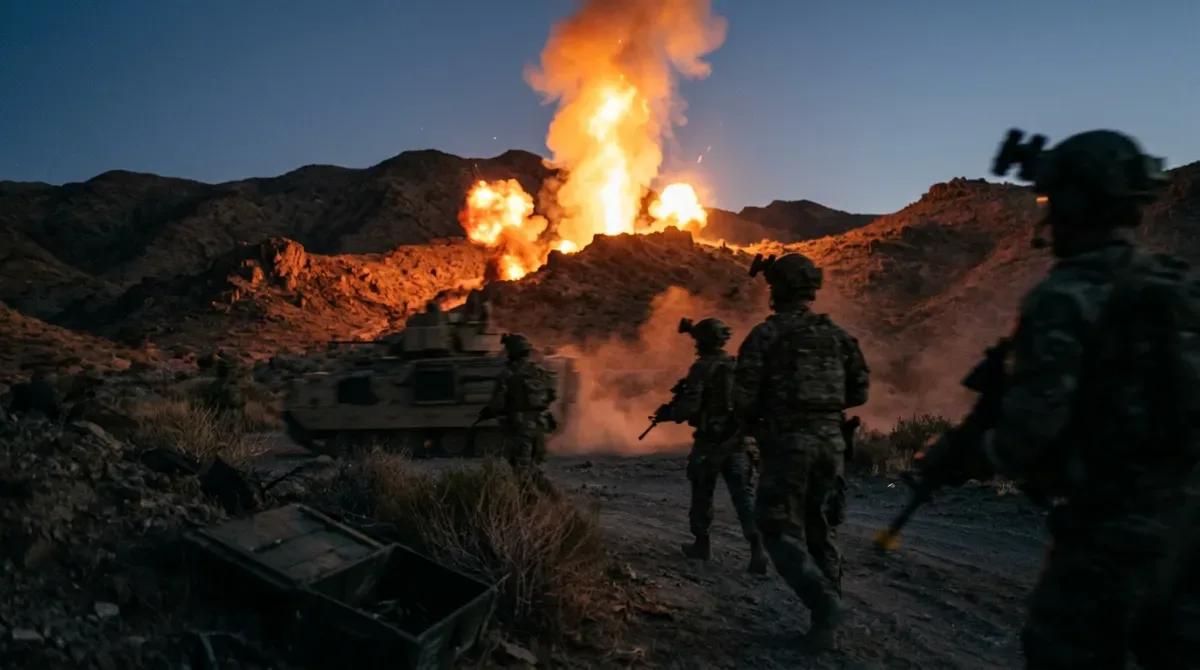
The United States military announced on Monday that it conducted "self-defense" strikes in southern Iran, targeting missile launch sites and minelaying vessels. This came as President Donald Trump declared on social media that negotiations were "progressing well." Captain Tim Hawkins, spokesperson for U.S. Central Command, stated that the strikes aimed to protect U.S. forces from threats posed by Iranian forces, while emphasizing that the military was "exercising restraint during the current ceasefire."
President Trump had conditioned any deal to end the Iran conflict on several additional nations, such as Saudi Arabia and Pakistan, joining the Abraham Accords. These Accords are U.S.-brokered agreements from his first term aimed at normalizing relations with Israel. This proposal has drawn criticism from Republicans advocating a tougher stance on Iran and could introduce new diplomatic complications into the negotiations.
Trump specifically called on Saudi Arabia and Qatar, along with Pakistan, Turkey, Egypt, and Jordan, to "immediately" sign the Abraham Accords. He emphasized that after all U.S. efforts to connect this "very complex puzzle," the simultaneous signing by all these nations is the "bare minimum." Bahrain and the United Arab Emirates were the first countries to join in 2020.
However, both Saudi Arabia and Pakistan maintain the position that any normalization deal with Israel requires first establishing a clear path for a Palestinian state. Analyst Syed Mohammad Ali in Islamabad affirmed that despite Trump's latest proposal, Pakistan's stance on Israel remains unchanged. While Egypt and Jordan have long recognized Israel and have peace treaties, further participation in these Accords is another matter.
Former Pakistani Ambassador to the United States, Masood Khan, commented that mentioning the Abraham Accords at this stage has added a completely new dimension to diplomatic and reconciliation processes. He pointed out that this issue was not originally on the agenda and that Trump is facing domestic pressure to achieve a favorable agreement. However, Khan also believes that "the diplomatic path is still working, and Pakistan is very important in it, supported by regional countries."
The Abraham Accords are a series of diplomatic, economic, and security agreements forged under U.S. influence during President Trump's first term. Initially, these agreements were signed between Israel and the United Arab Emirates and Bahrain, followed by Sudan, Morocco, and most recently, Kazakhstan. The primary goal is to foster cooperation among nations in the Middle East and North Africa while paving the way for full relations with Israel.