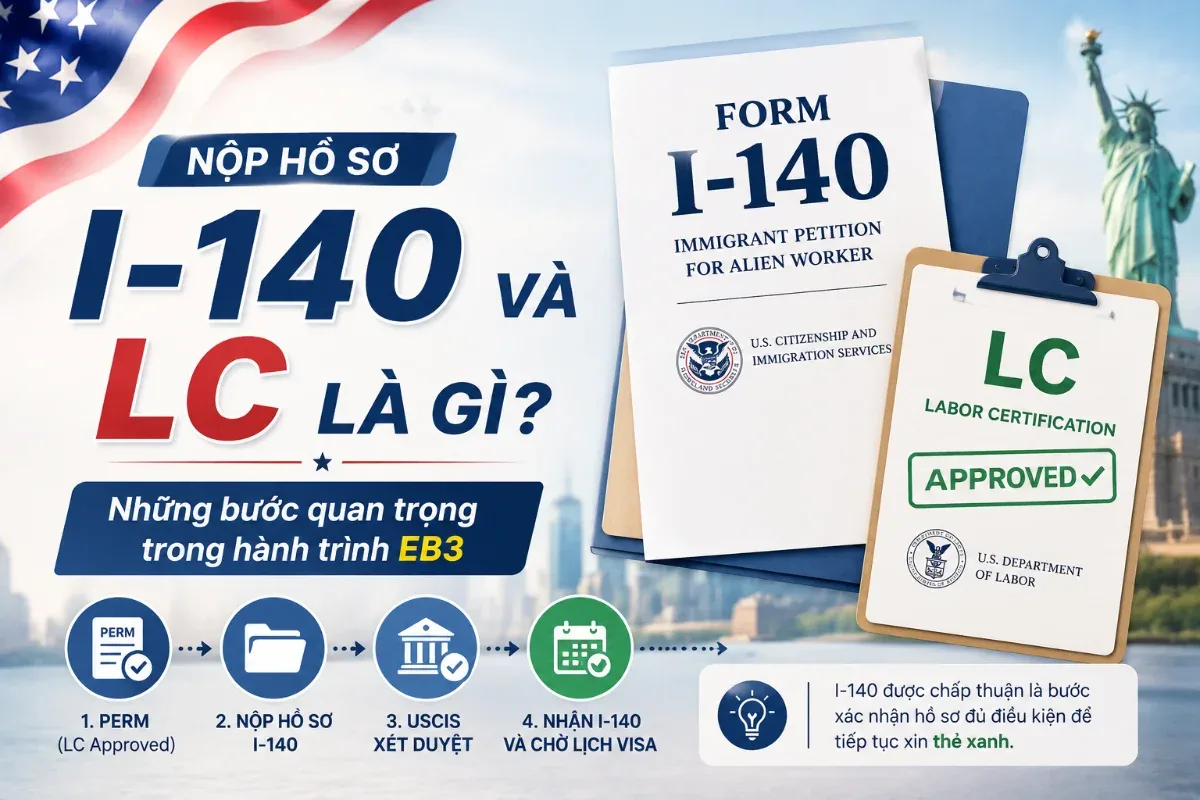
After the U.S. Department of Labor approves the PERM application, many EB3 employment-based immigration applicants begin the next stage called I-140—a procedure considered a significant milestone in the journey to obtain a U.S. Green Card.
In the EB3 applicant community, many people often mention the phrase “LC approved” or “having LC.” In reality, “LC” stands for Labor Certification—the PERM labor certification issued by the U.S. Department of Labor.
Once the LC is approved, the sponsoring employer can proceed to file Form I-140 with the U.S. Citizenship and Immigration Services (USCIS).
According to USCIS, the full name of Form I-140 is:
Immigrant Petition for Alien Worker.
This is the document through which a U.S. business officially requests government approval for a foreign worker to immigrate for employment.
At this step, USCIS will review:
• Whether the sponsoring company has sufficient financial capacity
• Whether the job recruitment is legitimate
• Whether the worker is suitable for the recruited position
• Whether the previous PERM application was valid
If the I-140 is approved, the case will have a “priority date” to continue waiting for visa availability according to the Visa Bulletin.
Immigration lawyers say many people often mistakenly believe that an I-140 approval is equivalent to having a Green Card. However, this is only the step confirming that the labor sponsorship application is eligible to continue the immigration process.
After the I-140, the applicant must still:
• Wait for the visa bulletin to become “current”
• Submit an application for an immigrant visa or Adjustment of Status
• Undergo interviews and background checks as required
Experts also note that applicants need to closely monitor the Visa Bulletin status, as wait times currently depend heavily on visa backlogs for each category and country.
In the current EB3 Unskilled category, many cases continue to wait several years after obtaining LC and I-140 approval before it is their turn to be issued a visa.