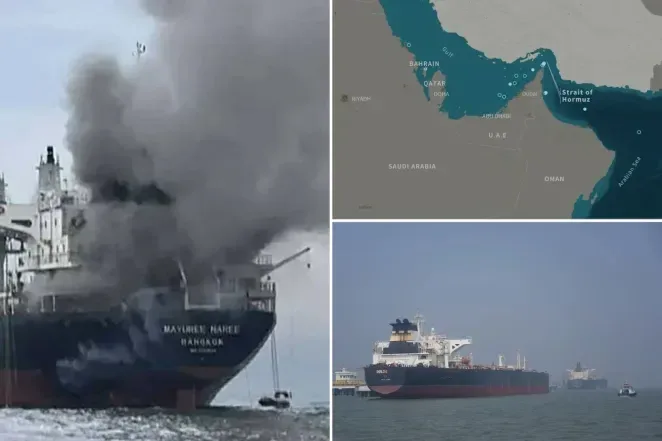
Iranian oil tankers are using secret signal codes to bypass Tehran's blockade at the Strait of Hormuz, according to a notable report.
This has helped dozens of vessels—all linked to countries still purchasing Iranian crude—escape the perilous shipping route, while thousands of others remain stranded in the Persian Gulf.
Tehran has effectively closed the strait due to hostilities, cutting off a route that previously saw about 130 ships pass through daily.
Since then, only about 90 vessels have been able to pass, according to maritime tracking data.
Huax, a German-Italian maritime intelligence firm, stated that the vessels that passed through were either linked to the Iranian oil industry or had been granted permission, with ships emitting secret signals to confirm their eligibility for transit, according to The Times of London.
“Whether it's a signal to Tehran or an internal identification code for the fleet, we cannot confirm, but these signals are coordinated across multiple vessels,” said Arsenio Longo, a maritime intelligence expert at Huax.
“Vessels linked to India and China appear to be moving or preparing to move, while almost all other commercial traffic remains blocked,” he added.
Some ships are also broadcasting messages such as “GOVT OF INDIA SHIP” and “INDIAN SHIP&INDCREW,” suggesting India has achieved some level of negotiation for a safe corridor with Iran.
Approximately 20% of the global oil supply passes through the Strait of Hormuz, and Iran's blockade has left around 2,000 ships stranded in the region, according to the International Maritime Organization (IMO).
The IMO has called on nations to urgently find ways to evacuate the stranded vessels, which are currently carrying about 20,000 crew members.
Vessels attempting to pass through the strait without Tehran's authorization face a risk of attack, with approximately 20 ships hit this month.
Despite the instability, Iran has exported over 16 million barrels of oil, mostly to China, according to estimates from trade data and analytics platform Kpler.
At least 14 Iranian-flagged tankers have also arrived at the Singapore Strait, according to analysis from the U.S. advocacy group United Against Nuclear Iran (UANI).
For Iran, the situation is described as “business as usual,” Charlie Brown, a senior advisor at UANI, told Reuters, with another 15 of Tehran's vessels returning to the Gulf after unloading in Asia, despite Western efforts to protect oil shipping routes through the Strait of Hormuz.
As Iran maintains near total control of the Strait of Hormuz, lawmakers in Tehran have discussed establishing new regulations to collect transit fees for the route, according to state media.
This would allow Tehran to control the economic flow through the strait, similar to how Egypt controls the Suez Canal.