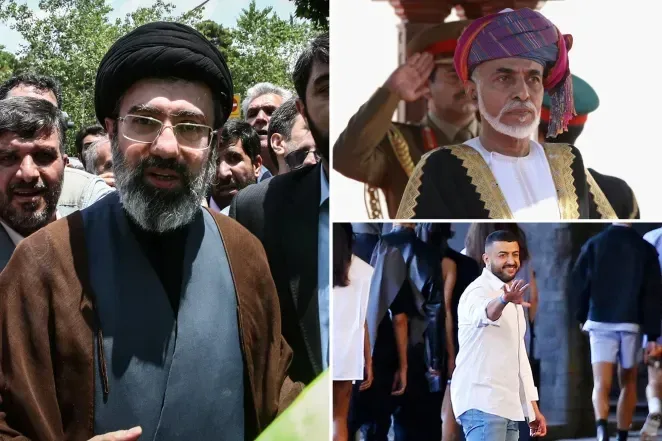
A U.S. intelligence report suggests that Iran's new Supreme Leader, Mojtaba Khamenei, "may" be gay — but he is not the only powerful Middle Eastern figure rumored to be so.
For decades, whispers have circulated about the late Sultan of Oman, as well as a short-lived Hamas leader.
A son of a United Arab Emirates emir was reportedly criticized by his father and forced to leave before being found dead of a drug overdose.
These "untold truths" within ruling circles persist despite Iran and most other countries in the region having severe penal laws against homosexual acts for ordinary citizens.
Reports regarding Mojtaba Khamenei’s sexual orientation were revealed in early March during a high-profile U.S. intelligence briefing, with sources telling The Post that he had a long-term relationship with his childhood tutor.
According to leaked diplomatic cables, he also struggled to find a wife and underwent several treatments for "impotence" in London as a young man.
His father — who was killed in the initial strikes of the war in Iran — was also said to have stated that his son should not be chosen as a successor amid controversy over who would lead Iran after his time.
The Middle East has long had a history of an underground gay life — in some places, sexual acts between young men are tacitly accepted and viewed as a "passing phase."
And then there is the Sultan of Oman — Qaboos bin Said — the 15th ruler in his dynasty and the Middle East's longest-serving monarch at the time of his death in 2020.
Despite his prestigious background and personal wealth of nearly $700 million, he was only married briefly and was said to have had many attractive male aides in his palace.
In his obituary, The Times mentioned "rumors of relationships with handsome young European men."
The Daily Mail reported that his sexual orientation was widely known among the ruling elite, and he was believed to have had a long-term relationship with a man from Britain.
Meanwhile, Oman maintained strict punishments for homosexuality under his rule and continues to do so today.
Not just leaders, but some other members of the elite also seem to be "overlooked," while ordinary citizens must live in fear and secrecy.
The brother of the slain Hamas leader Yahya Sinwar — Mohammed Sinwar — was accused of sexually abusing boys while in prison, according to Israeli media.
He was protected by Yahya, even though Hamas is notorious for torturing gay people to death.
Yahya Sinwar, the mastermind behind the October 7, 2023 attack, once tortured a senior commander to death in 2016 after information emerged that he had relations with other men in prison.
One of the sons of Libyan leader Muammar Gaddafi, Saif al-Arab Gaddafi, was also rumored to have relationships with both men and women.
However, not everyone enjoys "privilege." Some leaders have attacked their own relatives over their sexual orientation.
Sultan bin Muhammad Al-Qasimi — the ruler of Sharjah in the UAE — once tried to imprison his son Khalid al-Qasimi for being gay.
Al-Qasimi later fled to Britain but was found dead of a drug overdose at the age of 39 in 2019.
In Iran, sources told The Post that the 56-year-old Khamenei made "aggressive" advances toward male doctors while under the influence of medication while being treated for injuries from the February 28 U.S. airstrike — the attack that killed his father and pushed Iran into war.
His sexual orientation is said to be an "open secret" among Iran's top leadership, and U.S. intelligence also reported that he had undergone several treatments for "impotence" in the past after being unable to conceive with his wife.
The issue was so serious that he was hospitalized for treatment at least four times — including one stay lasting at least two months — before being able to father children with his wife.
He also had two "temporary marriages" — a form allowed by Islamic law for sexual relations without a long-term marital commitment — to "practice" before his official marriage.
Both his wife and son were killed in the airstrike that eliminated his father and at least 49 high-ranking Iranian officials.
Khamenei was reportedly severely injured in the attack and has not reappeared since.
Nevertheless, he was appointed Supreme Leader on March 8 after a secret vote, reportedly heavily influenced by the Islamic Revolutionary Guard Corps (IRGC).
President Trump — who once called him "impotent" and reportedly laughed upon hearing news that he might be gay — declared the new leader "unacceptable" and expressed dissatisfaction with Tehran's new leadership if they do not comply with U.S. demands.
Iran has reportedly agreed to stop pursuing nuclear weapons, according to a statement by President Trump on Tuesday, but Tehran continues to deny negotiating with the U.S.
The U.S. War Department is also preparing to deploy troops to the Middle East with approximately 3,000 soldiers from the 82nd Airborne Division.
Iran has previously agreed to halt its nuclear program but subsequently continued operations in secret.